


Last week we attended the Global Digital Collaboration conference in Geneva, and on Day 2 we announced from the main stage the 𝗣𝗮𝗻-𝗘𝘂𝗿𝗼𝗽𝗲𝗮𝗻 𝗧𝗿𝘂𝘀𝘁 𝗙𝗿𝗮𝗺𝗲𝘄𝗼𝗿𝗸 (𝗣𝗘𝗧𝗙) initiative.
Framing the context
The Global Digital Collaboration conference, GDC26, it can be considered the event of the year for digital identity (and beyond).

Geneva, following its long-standing tradition of global convenor, became for three days a unique melting pot of the most brilliant minds working on making digital identity a global infrastructure for everyday life.
The multistakeholder approach is real and tangible: International Organizations, UN Agencies, Standard-Setting Bodies, Ministries and Government Representatives, Bigtech and Corporate Giants, but also Bold Startups, Foundations, Academic Experts, NGOs, Open Source heavyweights, all together for 3 days, through a total of 140+ sessions.
Our Session
We are grateful to the GDC Secretariat to welcome us, and we thank you Steffen Schwalm (CEN-CENELEC) to invite us to coordinate a panel of a diverse group of distinguished experts from OECD, Council of Europe, W3C, Ethereum Foundation, UN/CEFACT.
That was the only way we could cover all aspects a regional trust framework should consider: from policy to rights, from technical stadards to privacy, from business needs to cross-border interoperability, and all in between.
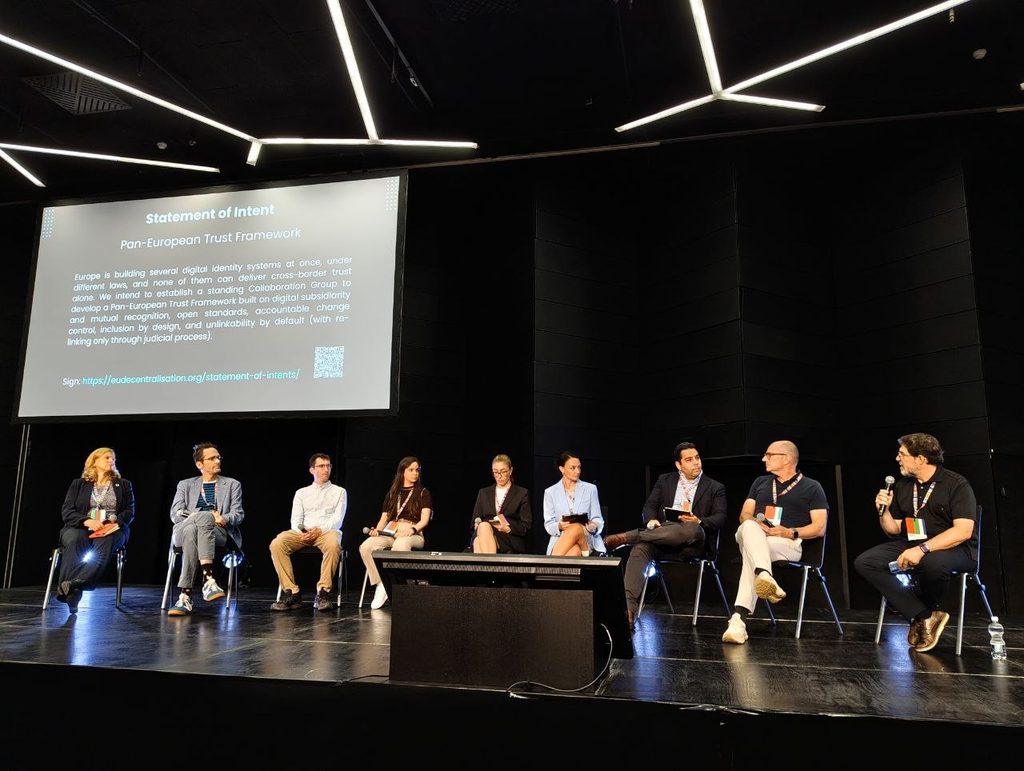
The need and urgency of this initiative were made clear on stage:
- Arno Laeven set the stage, outlining the PETF perimeter and its genesis, building on Priority 4 of our policy brief released in May 2026.
- Felipe González-Zapata and Ana Tokhadze shared the work both the OECD and the Council of Europe have done, and are doing, in this field, and how the PETF principles align with their recommendations and legal instruments.
- Christiana Aristidou and Vivian Plasencia explained why this really matters, covering the legal implications on one side and the possible technical solutions on the other, to operationalise key principles such as digital subsidiarity and unlinkability.
- Will Abramson shared the standardisation efforts W3C has brought forward in recent years, and how DIDs and VCs are becoming de facto global standards that the PETF should embrace.
- Steffen Schwalm showed how global standards are already being tailored to the European dimension, particularly through the work of JTC 19, and how this positions the PETF as an open, compliant and globally interoperable framework.
- Dr. Susanne Guth-Orlowski closed the panel, drawing on her long-standing work at UN/CEFACT to lay out concrete, urgent use cases in overlapping domains, particularly DPPs, where the PETF could be the real solution.
- A particular thank you to our fellow Ignacio Alamillo, for taking on the duty of moderating such a broad panel.
We are now collecting initial feedbacks, and we are eager to receive further inputs from the GDC community and beyond.
More updates to come. Working on securing trust for digital identity at scale.
Read more about PETF and join the Collaboration Group: https://eudecentralisation.org/statement-of-intents/

